
Understanding Compilation in Programming
Programming languages are the backbone of software development, enabling developers to communicate with computers and create a wide range of applications. One crucial aspect of programming is the compilation process. In this article, we will delve into the meaning of compilation, the role of a compiler, and provide an example of a compilation.
What does Compilation mean in Programming?
Compilation is the process of converting human-readable source code written in a programming language into machine-readable code that a computer can execute. This transformation involves several stages, including lexical analysis, syntax analysis, optimization, and code generation. The output of this process is typically an executable file or another form of code that can be executed by a computer.
Stages of Compilation:
- Lexical Analysis: This stage involves breaking down the source code into tokens, such as keywords, operators, and identifiers.
- Syntax Analysis: The compiler checks the arrangement of tokens to ensure they adhere to the grammar rules of the programming language.
- Optimization: The compiler may optimize the code for better performance, eliminating redundancies and improving efficiency.
- Code Generation: The final stage involves generating machine code or another intermediate representation that can be executed by the computer.
What is a compiler in programming?
A compiler is a specialized program responsible for carrying out the compilation process. It acts as a translator, converting high-level source code into low-level machine code. The compiler plays a crucial role in ensuring that the code written by developers is transformed into an executable format that can run on a computer.
Key Functions of a Compiler:
- Translation: The primary function of a compiler is to translate the source code into machine code or an intermediate representation.
- Error Checking: Compilers perform thorough checks to identify and report any syntax errors or logical inconsistencies in the code.
- Optimization: Compilers often apply various optimization techniques to enhance the performance of the generated code.
- Code Generation: The final output of a compiler is the executable code that can be run on a computer.
What is an example of a compilation?
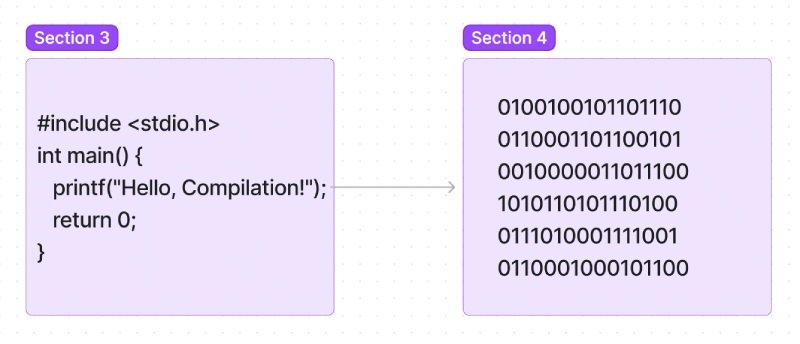
Let’s consider a simple example of a compilation process using the C programming language.
#include <stdio.h>

int main() {
    printf("Hello, Compilation!");
    return 0;
}
In this example:
- Lexical Analysis: Identifies tokens like
#include,int,printf, etc. - Syntax Analysis: Checks the structure of the code to ensure it follows the rules of C syntax.
- Optimization: May optimize the code for efficiency.
- Code Generation: Produces machine code or an executable file.
This executable file can then be executed to produce the output: “Hello, Compilation!”
Conclusion
Understanding the compilation process and the role of compilers is fundamental for any programmer. It ensures that the code we write can be transformed into a format that computers can understand and execute. As technology evolves, so do the tools and techniques used in compilation, contributing to the efficiency and performance of software development.